
How We Coach
We are proud that our EDGE Coaching Framework is developed by experienced coaches who have worked in the top tiers of both men and women’s football.
The framework is developed inline with FA technical guidelines as well as through academic research, ensuring our players learn all the technical and tactical skills required to play the game at an elite level via the latest coaching methods.
Long-term Athletic Development (LTAD)
Long-Term Athlete Development (LTAD) is a framework that guides training, competition, and recovery based on an athlete’s developmental stage. It aims to help athletes realise their full potential and enhance the quality of sports programs. By following planned steps, athletes of all ages can improve their physical performance. LTAD focuses on gradual progress for long-term success, encouraging athletes to prioritise development over short-term gains. The seven-stage framework tailors support to an athlete’s needs, enhancing learning and performance quality. Coaches using LTAD are more likely to help athletes reach their potential, and the model promotes participation and recognises all stages of athleticism. At WCFC, staff assist coaches and parents in applying LTAD principles, emphasising factors like physical literacy, specialisation, and emotional growth to support athletes in achieving their best.
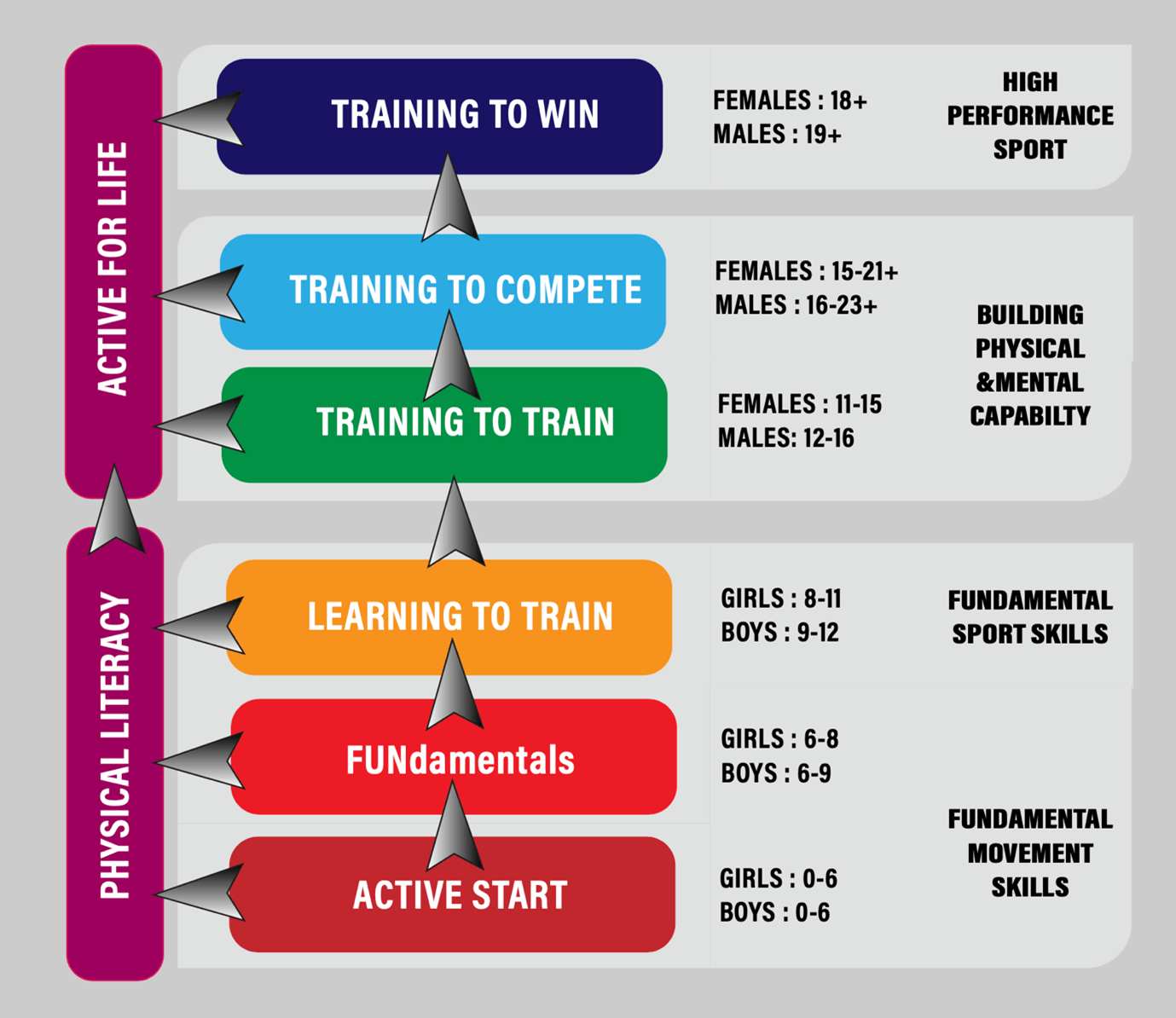
Seven Stages of LTAD
1
Active Start – As the exciting first stage of the Long-Term Athlete Development (LTAD) model, the objective of Active Start is to make physical activity a thrilling and enjoyable part of everyday life. It inspires athleticism in a child’s daily routine through fun play. From ages 0-6 for both boys and girls, this stage lays the foundation for fostering a positive attitude toward sport and nutrition that will benefit children throughout their lives.


2
FUNdamentals – This Fun stage sharpens motor skills through the essential ABCs: agility, balance, and coordination. It elevates the enjoyment of play and sport by emphasising structured movements like running, jumping, kicking, catching, and twisting. Designed for ages 6-9 for males and 6-8 for females, this stage inspires a spirit of exploration in sports while ensuring a fun and safe experience for all!
3
Learning to Train – This dynamic phase builds on the basics, focusing on the essential physical, mental, and emotional aspects that drive success in sports. It’s a pivotal time when kids master motor skills, showcasing their unique traits. As boys and girls exhibit different strengths, training guidelines evolve to become more tailored to their individual needs. For boys, this exciting stage begins between ages 9-12, while for girls, it commences from 8-11, establishing a solid foundation for their future sports endeavours!


4
Training to Train – The Training to Train stage of the Long Term Athlete Development (LTAD) Model is regarded as the most difficult and vital transition. During this period, individuals begin to hone athletic-specific skills while experiencing significant physical changes that require careful monitoring for both mental and physical well-being. This stage occurs between the ages of 12-16 for males and 11-15 for females. Prioritization will be placed on the development of endurance, strength, and speed. The rapid growth phase also presents risks for the establishment of detrimental habits; thus, it is imperative that flexibility, posture, and technique are rigorously monitored.3
5
Training to Compete – This stage is essential for integrating competition into the athlete’s development. It emphasises mental, emotional, and cognitive preparedness alongside physical readiness. As competition is embraced, specialisation occurs, enabling athletes to implement targeted protocols that highlight their strengths and identify areas for improvement. Between the ages of 16-18 for males and 15-17 for females, advanced motor skills are prominently developed. Key abilities such as speed, strength, endurance, and power are significantly optimised.


6
Training to Win – In this phase, the primary focus is on enhancing performance as the individual transitions to the status of a “full-time athlete.” Throughout this period, the mental, emotional, cognitive, and physical growth of the athlete is meticulously observed to facilitate their professional aspirations. For both male and female athletes aged 20 to 23, their abilities are rigorously tested while they are educated on the significance of healthy competition.
7
Active for Life – This last stage is super important but often gets overlooked. It kicks in after an athlete has hung up their competitive gear and helps them adjust to a whole new way of living. It can happen at any age for both males and females and gives retired athletes a sense of direction and purpose in their day-to-day lives.

Youth Physical Development (YPD)
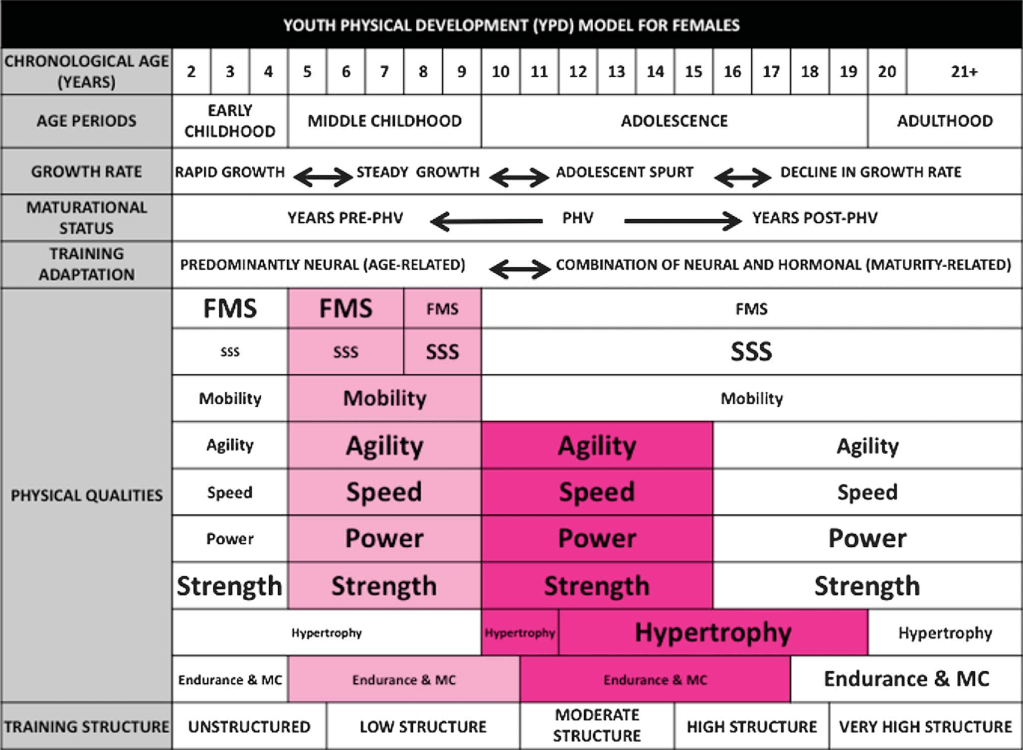
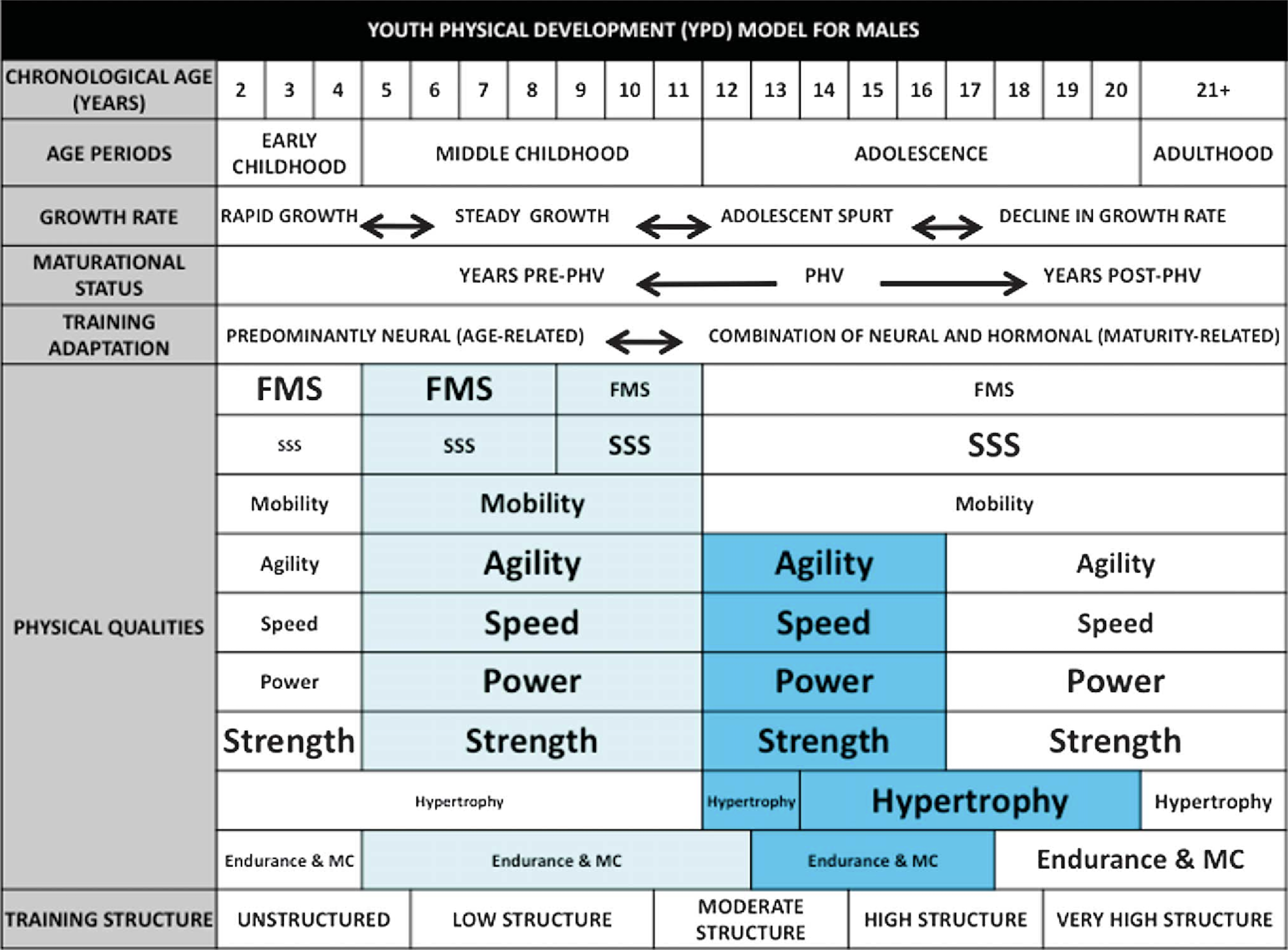
Youth athletic development demands careful attention. Children are not “mini-adults,” and their training must accurately reflect their growth and maturation. While existing LTAD models have centred around theoretical windows of trainability, often lacking substantial evidence, earlier models segmented athlete development by age stages, neglecting the impact of biological maturity. Recent models, however, leverage growth measures such as peak height velocity (PHV) to effectively steer training practices.
The YPD model encompasses ages 2 to adulthood, clearly outlining the optimal emphasis on various fitness components at each stage. The font size within the model highlights the priority of these components. It serves as a comprehensive guide for both males and females, demonstrating the necessity for the continuous development of multiple fitness qualities, with a strategic shift in emphasis as time progresses. The YPD model firmly establishes that most fitness qualities are trainable throughout childhood. The early years prioritise strength, movement, speed, and agility, while adolescence brings a focus on power, hypertrophy, and sport-specific skills. Individualisation and qualified coaching are crucial for achieving long-term success.

Initial Training Status
Our coaches will take an athlete’s training age into account when designing training programs, focusing on foundational skills for older athletes who missed early training stages. For early maturing young athletes with advanced abilities, coaches will implement more advanced training rather than just age-appropriate methods.
Individualised LTAD
The YPD model is relevant for average maturing children of both sexes, but our coaches work with athletes at various maturation stages, ages, and training histories. Previous models have acknowledged these factors, but their specific impacts on training prescriptions remain uncertain. The next section will discuss how our coaches adapt the YPD model to consider these factors.
Early/Late Maturers
An LTAD model must be flexible due to individual maturation timing in children. Early maturing children begin their growth spurts 1.5 to 2 years earlier than late maturing children. Although adult height is unaffected by maturation timing, our coaches will tailor training approaches for early and late maturers differently than for average maturers. Regular monitoring of a child’s height and weight helps estimate growth rates and biological age. In the YPD model, adjustments are made for early maturers to start advanced training sooner, while late maturers begin later, when they are ready. Training plans will align with the child’s biological age for greater consistency and accuracy.
Boys vs Girls
The participation of children and adolescents in organised sports has increased, with more boys than girls involved. Our coaches to understand the physiological and developmental differences between genders to design effective training programs. During prepubescence, boys and girls develop similar physical abilities and can follow the same training routines, focusing on fundamental movement skills and strength. This period is important for building bone mass through suitable weight-bearing exercises. As adolescents grow, boys typically progress more in physical fitness, while girls start their growth spurt earlier and may experience physiological changes that increase their risk of non-contact anterior cruciate ligament injuries. The YPD model suggests using training strategies, including plyometrics and core strength workouts, to mitigate these risks in female athletes.
FUNdamental Movement Skills (FMS)
FMS development is important for health, well-being, and physical performance, serving as the foundation for sport-specific movements. It should be emphasised in physical development programs for young children to improve gross motor skills. Adolescents can start using FMSs in competitive environments as they reach puberty, and these skills should be included in strength and conditioning programs for athletes of all ages. The YPD model highlights the focus on FMS until puberty, after which attention shifts to SSS, while both remain relevant throughout childhood and adolescence.
Mobility
The YPD model emphasises that mobility is not a main focus in childhood training. Nevertheless, mobility development is vital for athletes, especially during middle childhood (ages 5–11), which is regarded as a critical period for flexibility training. Research indicates that boys lose trunk forward flexibility between ages 9 and 12, whereas girls improve significantly starting at 11. Hence, prepubescence is a key time to develop mobility, and adolescents and adults should prioritise maintaining it.
Strength
Children can safely engage in strength training under qualified supervision, with the LTAD model identifying a key development window 12–18 months after PHV. Strength gains result from a combination of muscular, neural, and mechanical factors rather than just muscle fibre growth. It is crucial to focus on strength development in both prepubertal and adolescent youth, as it is essential for various physical abilities and can help reduce injury risks. Research shows that muscular strength significantly affects motor skills in youth, and strength training can prevent sports-related injuries. The National Athletic Trainers’ Association suggests that many overuse injuries in youth sports could be mitigated through proper strength development, which should be prioritised over other types of training.
Agility
Agility is an important yet often neglected component of fitness in children but is essential for sports performance. The YPD model emphasises training during prepubescence and adolescence, highlighting key aspects like change of direction speed and cognitive function. These stages are ideal for enhancing muscle coordination and basic agility skills. Although cognitive abilities related to agility improve in late childhood and adolescence, further research is needed on their effects in sports contexts. As training progresses, agility activities should increase in difficulty. Adolescents may experience coordination challenges due to growth spurts, therefore our coaches will closely monitor development and adjust training accordingly.
Speed
The LTAD model links speed development primarily to age, indicating that neural adaptations are key for speed gains, however, research also shows that maturation influences speed development in young athletes, suggesting it can improve throughout childhood and adolescence. A review found that prepubescents benefit from high-neural activation training, while adolescents respond better to training that develops both neural and structural aspects. Thus, prepubescent children should focus on plyometrics and sprinting, while adolescents should prioritize strength training and plyometrics to boost overall speed.
Power
The ability to generate high power is important for sports success. Vertical jump height serves as a simple measure of muscular power in children. The YPD model highlights that power development starts in adolescence and continues into adulthood, with a need for training in the prepubertal phase as well. Research shows that both children and adolescents can improve muscular power through training, and while muscular power can be developed throughout childhood, the rate of growth may differ before and after puberty.
Hypertrophy
The YPD model indicates that muscle growth training should begin around age 14 for boys and 12 for girls, typically after peak height velocity when hormone levels rise. Gains in muscle size before puberty may be limited due to lower hormone levels, so the model recommends focusing on strength training before adolescence and integrating strength and hypertrophy training afterward to improve muscular strength and performance.
Endurance & Metabolic Conditioning
Early research on the trainability of young people shows mixed results, with some studies suggesting better responsiveness to training around peak height velocity (PHV) and others finding gains in children before reaching PHV. Growth-related changes in cardiovascular function and metabolism are believed to influence endurance and conditioning throughout childhood. The YPD model suggests an increased focus on endurance as children mature, though not as a main training emphasis. Most sports do not require extreme endurance, which can still be developed into adulthood.
 Warwick County Football Club